

- Details
- Written by Super User
- Category: Seven Churches
- Hits: 1580
The Seven Churches: Laodicea
The church of Laodicea is easily the most famous of the seven churches in the Book of Revelation. That’s not because Jesus saved the best for last. They were indeed last—last in line on the mail route and lagging way behind at running faith’s race. In fact, they weren’t running, or even walking with Jesus or towards Him. They weren’t running away either, or even running to the devil. He said He could have worked with any of that. What were they doing? They were “living the dream”—using His blessings to feather their own nest. They thought they had it made, but they couldn’t have been more wrong. Many have said that the church in America fits this picture all too well.
"I know your works: you are neither cold nor hot. Would that you were either cold or hot! So, because you are lukewarm, and neither hot nor cold, I will spit you out of my mouth." Revelation 3:15-16
All scripture citations are from the English Standard Version (ESV) unless otherwise noted.
Chief Characteristics
Whole books are written about most of these crucial components. These characteristics are summaries of what is grounded in scripture, not fabricated through speculation.[i] Speculation is trying to “see” more than we are being shown. What we see by Biblical revelation is real enough, but a fuller view will only come as these still distant components draw nearer.
Travellers, commerce and correspondence from Greece or Italy would arrive at Asia Minor's major seaport, Ephesus, then journey up the coast towards Pergamum, before turning east on the interior highway to Laodicea. The letter to the church at Laodicea would have been the last letter delivered.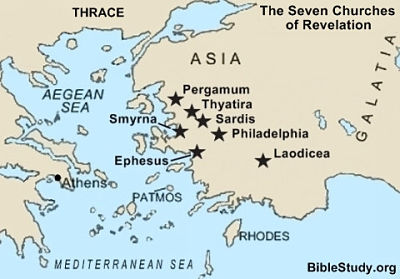
Laodicea sits at the end of the route that would have been traversed by anyone taking mail from Patmos to the other six cities addressed by these letters. Founded in the 3rd century BC, Laodicea became an important commercial center due to its position on the trade road connecting the coastal ports with the resources of Asia Minor’s interior. By the 12 century AD it became deserted due to warfare between the Byzantines and Seljuq Turks. Earthquakes in the 18th and 19th centuries completed its destruction.[ii]
Jesus knew this city well. When He spoke of hot and cold, He was pointing to the unique geography surrounding Laodicea. From city center one can see six miles to the north the hillside where ancient Hierapolis drew crowds to its famous hot springs and baths. Not far off, Mount Gokbel stands to high elevation (7,572 feet) and sends its cold waters into the Menderes River, then down the valley leading towards Laodicea. Hot and cold close at hand, yet the believers here were lukewarm. Jesus threatened to “spew them” out of his mouth if things didn’t change. Standing amid the present-day ruins, it is impossible to find a single building that has more than a fraction of its stone walls intact. For scores of acres all around, the countryside is covered with broken building stones—exactly as if some giant had chewed on them a while and spit them out. It is a lamentable and sobering sight.
Pre-Figured in Scripture
Every crucial component of the Last Days has already “appeared” in the Biblical prophetic narrative in the past, somewhat like a dress rehearsal for the final drama. These foreshadows are called “types” because they precede their ultimate expression (the “antitype”).[iii] As shadows of the future reality, however, they cast a revealing light of their own.
Esau: Despising His Inheritance
Is there someone in scripture who was lukewarm? Was there someone who had been offered an incredible inheritance, yet grew lackadaisical about it? Indeed, there was! And this was not just any inheritance but “the” inheritance. The seed line for the Messiah and the promise to Abraham were given to Esau. He didn’t even have to work to get it—it was given to him at birth. He only had to work to keep it. That’s sort of like us. We are granted salvation as a free gift at our new birth, but in some way have to “work out” our salvation through a process known as sanctification.[iv] That’s what Paul said he did and what we should do as well.[v] Apparently, the Laodicean Christians didn’t agree. Neither did this character. But they should have paid attention to his example. It’s a life lesson in what not to do.
As it happened, Esau had a brother who was desperate to the get that inheritance. To be sure, he was striving in the flesh. He was a usurper and a deceiver. But he knew a good thing when he saw it. Jacob went after the inheritance ninety to nothing. Now, you would think that should disqualify him—he really was an incorrigible rascal. Jesus, however, saw that Jacob was hot—that won the divine approval. When Esau proved he “despised” his inheritance by trading it for a bowl of porridge, he lost his position in salvation history. The lentils may have been hot, but he was lukewarm. That’s not what Jesus is looking for!
Jacob said, “Sell me your birthright now.” Esau said, “I am about to die; of what use is a birthright to me?” Jacob said, “Swear to me now.” So he swore to him and sold his birthright to Jacob. Then Jacob gave Esau bread and lentil stew, and he ate and drank and rose and went his way. Thus Esau despised his birthright. Genesis 25:31-34
The Book of Revelation Chapter 3:14-22
The Bible exposes the secret plans and deceptive operations of the dark kingdom, even as it unveils the glorious realities of what our God is doing. The truths of scripture are, therefore, our rock-solid building blocks for interpreting the times we are entering. Nevertheless, for biblical information to become true revelation both prayer and the Holy Spirit are needed.
To the Church in Laodicea
"And to the angel of the church in Laodicea write: 'The words of the Amen, the faithful and true witness, the beginning of God's creation. Revelation 3:14
The letter begins in the usual way, but don’t let that fool you. Jesus acknowledges “the angel of the church of Laodicea” exactly as He has done six times before.[vi] But something’s coming. Something they won’t want to hear—not unless they have the kind of wisdom Solomon recommends: “It is better for a man to hear the rebuke of the wise than to hear the song of fools.”[vii] Something tells us that if they had that kind of wisdom, they wouldn’t have wound up in the predicament about to unfold. This is reading ahead so we can be prepared.
Coming back to the text, Jesus says He is “the Amen, the faithful and true witness.” We know that He is faithful and true from the rest of scripture which describes His nature and His steadfast ways. However, these two titles are unique to this book. Jesus calls Himself the Amen and the Witness. Amen is a Hebrew word that signifies something, someone or some statement is faithful, reliable or established.[viii] As such it is used over one hundred times in the Bible. Jesus takes the word and applies it to Himself. His is the big Amen behind every little amen.
Jesus says that He is also “the” faithful witness. He is the ultimate Witness behind all true witnesses. Many have witnessed about what they’ve seen in Him, including the Father. What is He a witness to? He who is Truth told Pilate that He came “to bear witness to the truth.”[ix] He is the One who brings the light of heaven’s truth into every dark nook and cranny where falsehood tries to hide.
Having said He is the Witness, Jesus tacks on a closing thought that seems a bit out of step. He is “the beginning of God’s creation.” How did we get there? Certainly, creation began with Jesus and He was there in the beginning.[x] However, considering the previous two titles this may be an allusion to how creation began—on a foundation of truth that was well-established, faithful and reliable. He is coming back to correct what went wrong, what grew false. That would include the believers in Laodicea.
15 "'I know your works: you are neither cold nor hot. Would that you were either cold or hot! 16 So, because you are lukewarm, and neither hot nor cold, I will spit you out of my mouth. Revelation 3:15-16
Without any fanfare, Jesus lowers the boom. There is not a single word of encouragement or recognition preceding what comes next. It’s a blistering rebuke: “I know your works: you are neither cold nor hot.” This puts such a bad taste in His mouth that He warns, “I will spit you out of my mouth.” That is not something any believer wants to hear. We secretly hope to hear Him say, “Well done good and faithful servant.”[xi] Not, “What have you done? You faithless servant!” Nevertheless, these are the words scorching the Laodicean ears. How can they bear it? The Lord’s indignation is hot against them because they are “lukewarm.” If His words don’t light a fire under them nothing will.
Hot and cold (or cold and hot) appear together three times in this one verse. The repetition carries meaning. Holy, holy, holy is heaven’s refrain. Anything scripture repeats three times has special significance. In the back of one’s mind the Trinity faintly echoes through this pattern. Could it be that these apathetic believers are neither hot nor cold towards the Father, the Son, or the Holy Spirit? Is not One of the Godhead worthy of either their attention or their ire?
We say of outstanding personalities we know that “you’ll either love them or hate them” to friends who haven’t met them yet. CS Lewis wrote that if you can stand in front of a beautiful sunset or the Mona Lisa and feel nothing, there’s something wrong. That’s what Jesus is getting at. How can these believers have been introduced to Jesus who died for them and say, “Oh well, been there, done that”? How can the God in heaven be made known as their loving Father and final Judge and they let the connection go dead? How can the Holy Spirit be living within them, ready to guide them into truth and life and they could care less?
We see what’s at stake, but they don’t. Are they trying to navigate a middle path? Some call it being “inoculated” by the gospel—just enough Christianity to get you feeling safe and saved, but not enough to be a bother. We saw in the previous letter the peril of what too much religion can do when zeal goes off track. But zeal has a good side, too. It’s been said that a religious fanatic is someone who loves Jesus more than you do. Trying to avoid extremes can become extremely compromising.
Jesus would rather see extremes, than a muddled, complacent middle. He would see hot: Someone in hot pursuit of Him, passionate even if a bit mis-guided. Or He would see cold: Someone who has shut Him out and barred the door and is making no pretense about it. What He hates is the hypocrisy that pretends to be good but disregards Him. Where’s the goodness in that? Worse, He seems to be saying that it’s harder for Him to work with lukewarm pretenders, than notorious sinners or zealous fanatics. At least if you’re on the go He can guide you or turn you around, but if you’ve stopped dead in the water…
For you say, I am rich, I have prospered, and I need nothing, not realizing that you are wretched, pitiable, poor, blind, and naked. Revelation 3:17
Complacency is their problem. In their eyes they’ve arrived. No need to press on or press in for a higher prize.[xii] They’re saying to themselves, “I am rich, I have prospered, and I need nothing.” What? Don’t they “need” to be living their lives for Jesus, rather than themselves? Don’t they need to be forging a lasting relationship with Him? Perhaps they’re taking their present blessings as a sign that He’s pleased with them. They couldn’t be more wrong! In His eyes they’re “wretched, pitiable, poor, blind, and naked.” In the normal course of things, anyone in such dreadful conditions would be exactly the sort of person Jesus wants to save. But they’re “saved” already!
Now we see the problem they don’t see. If only they knew how miserable their condition is in God’s sight, they would be crying out for help. Usually, the average person being readied for salvation, feels how desperate their condition is and calls on God. These "saved" believers need Jesus just as desperately as when they first began, but they don’t feel the need, nor do they see it. That’s why Jesus is “shouting” at them. He has to shock them into “realizing” their reality.
I counsel you to buy from me gold refined by fire, so that you may be rich, and white garments so that you may clothe yourself and the shame of your nakedness may not be seen, and salve to anoint your eyes, so that you may see. Revelation 3:18
Now that He has their attention, He can offer remedies with each one shaped to match their need. Again, it should be noted that this is the Bride Jesus loves despite her blemishes. For this reason, He’s not making demands. Instead, He offers “counsel.” Because they’re poor in the real treasures, He recommends buying “gold refined by the fire.” During His Galilee days, Jesus warned us not to “store up treasures on earth” but only those in heaven.[xiii]
Jesus didn’t explain what the heavenly treasures are then or now, but we can speculate. These would be the things we can take with us or those that will be given to us there. Anyone we work with Him to save—whether family member, friend or stranger—will be a genuine treasure we can “take” with us. So, will any and all virtues He works into our character, including wisdom, knowledge and skill. Heaven will supply us with treasures of reward—the crowns He keeps mentioning are only a part of it—for all the good we do under His leadership. Even so, the greatest treasure will be the level of intimacy we reach with Him here—that will somehow set the tone or the starting point of our intimacy with Him there. He is the highest treasure and heaven’s greatest reward.
Jesus prefers to see His beloved Bride properly clothed. We saw this same concern expressed in His letter to Sardis and investigated it there. Here, we see that the underlying problem for them (as for us) is their “nakedness.” Ever since the debacle of Eden nakedness in public is a sign of original disgrace, not innocence. We cannot go back to that. Indeed, whatever may have been the first plan is a thing forever covered up before our ever-curious eyes. When we peer into heaven by the light of scripture, we see everyone fully clothed there. Why was it “good’ for Adam and Eve to be without clothes? How could it have continued? Could it have continued into heaven? We’ll never know. We know for certain, however, that it’s not good for us to be naked.
Our spiritual garments are of two kinds, because our nakedness is of two kinds. There is the shame of sin. There is also the shame of our brokenness, which includes our wide-ranging weakness and ignorance, our wounds and inabilities. The garment of salvation covers our sin. We are “covered” by the Blood of Jesus. God our Father sees the Blood covering us and we’re good to go. This is widely taught. The other covering we need is not as well understood. He gives us the robe of His Righteousness to cover our shameful inability to show forth any righteousness of our own. Where the Blood covers our sinfulness, His Righteousness covers our weakness. See “Our Righteous Covering” for more on this at ouramazinggod.org.
To the robes, Jesus adds salve to “anoint” our eyes. Without the holy scriptures and the Holy Spirit, we are blind as bats. The salve that saves is the anointing of the Spirit combined with the reading of His Word. It takes both to restore spiritual sight. Our condition is such that this needs to be done daily. We don’t just need to see Jesus well enough to get to heaven. That seems to have been part of the Laodicean problem. We need to see even more what it is that Jesus our Lord wants us to do every day, so that He can lead us to heaven step by faithful step.
Those whom I love, I reprove and discipline, so be zealous and repent. Revelation 3:19
Here comes the desired fire. Since the flame has gone out, the solution is to “be zealous and repent.” It’s fine to pray while walking, sitting or lying in bed, but this calls for hitting the knees, or possibly lying prone. Realize how badly you need to repent and pray like you mean it. Put your heart into it. This is called being awakened by the holy fear of God and it is a good thing. Fear of the fire of hell will put the fire of love into you for anyone who will save you from it. They had forgotten how badly they needed saving. They don’t need saving from Jesus or from the Father—He loves those whom He “reproves and disciplines.” They need saving by Him. They had been letting go of His Hand and were drifting from His saving embrace. Thinking you’re saved eternally, when you’re doing nothing on your end. That’s being lukewarm. That’s spiritual danger.
Behold, I stand at the door and knock. If anyone hears my voice and opens the door, I will come in to him and eat with him, and he with me. Revelation 3:20
This verse is often used by evangelists and that’s fine. It’s true and it works splendidly. The lost have the door of their heart shut to the Lord and don’t know how to open it. As they hear His “voice” speaking to them through the gospel, they unlock that door. As they open to Him, Jesus comes in. Then table fellowship abounds as the new convert shares with Him the living bread of divine truth and the joy-inducing wine of the covenant—the forgiveness of sins. That’s great. In fact, it’s out of this world. It’s also taken out of context.
Jesus isn’t speaking to the lost here. He is addressing believers who gather to worship Him in Laodicea in full knowledge of who He is. Well, they do at least know Him as Savior. If they knew Him well enough, they would be expending every ounce of strength and moment of time to get to know Him better. To know Him is to love Him. To love Him is to want to know Him better. This is the never-ending circle of divine fire that Jesus wants to see burning in the hearts of His followers. He’s not seeing it here.
As elsewhere in the letters, Jesus is casting His words through that past time to ours. To “anyone” who hears His voice He issues this call to come up higher. That can include the lost, of course, but we need to be very clear about the context—lest we fall into the sad plight of these lax Laodiceans. Jesus says He is standing outside His own church. He is “at the door” and knocking, hoping they will hear and let Him in. He can’t or won’t “come in” unless we do as He desires: throw the door of our heart wide. Yield our lives entirely to His will. Turn over the operations of our church to Him.
The one who conquers, I will grant him to sit with me on my throne, as I also conquered and sat down with my Father on his throne. Revelation 3:21
It takes fire to live at this level. It takes faith, love and hope that are fixed entirely on Jesus. As we have heard Him say to the other churches, it also takes listening, repenting, holding fast and obeying. There is much to conquer! The world, the flesh and the devils all require special handling. This is not a game the lukewarm can drift through playing half-heartedly. They don’t even know it’s going on. Others do. To those who hear this upward call and wake up, great things are promised. Jesus will grant His overcomers the right to “sit with me on my throne.”
How did Jesus get His throne? We could say that He’s had it from before time since He is God, but that would be the wrong answer. This is the throne of David, the throne of the Davidic kingdom. The One who sits on it holds David’s key of authority as we saw in the letter to Philadelphia. Only a Man can be David’s rightful heir and sit on David’s throne. Jesus had to pass all the tests first—in His humanity—just as He is asking us to do. He also had to conquer under trials and against temptations all the way to the cross. Now, He wants us to do the same. Then we can join Him on His seat. Being seated speaks of rest—rest from trials. Sitting on a throne speaks of authority. Both will come to the overcomers.
He who has an ear, let him hear what the Spirit says to the churches.'" Revelation 3:22
With this final word of promise Jesus wraps up His letter with the now familiar phrase, “He who has an ear, let Him hear.” We’ve heard it at the end of every letter, but we have also heard it before—long before. This is exactly what He said when describing John the Baptist to the crowds in Galilee and it fits wonderfully well into this context.
From prison John sent his disciples to ask Jesus, if He was the long-awaited Messiah. Jesus sent answer back by way of pointing to the supernatural works He was doing. Then, He turned to the crowds to give honor to John, saying that among those born of women there was none greater. Yet, John could only advance the kingdom. Not having the new birth, he couldn’t enter it.[xiv] We can. Jesus said that “even the least in the kingdom” is (somehow) greater than John. We who have received the new birth are uniquely graced both to advance the kingdom and to enter it. According to Paul, that kingdom is “righteous, peace and joy in the Holy Spirit.”[xv]
This kingdom is our true inheritance on the earth, our Promised Land. Entering it is our daily calling—and our great delight. Advancing it into other lives is our great commission—and our highest duty. That won’t happen without battles. This is heavily contested territory, otherwise every Christian would already be living in right ways, filled with peace and joy and fully empowered by the Holy Spirit. Jesus knows it. That’s why He told the crowds to prepare for war. Overcomers: You’ve got something to overcome!
From the days of John the Baptist until now the kingdom of heaven has suffered violence, and the violent take it by force... He who has ears to hear, let him hear. Matthew 11:12, 15
Next Sextion
Sucessive Judgments When the seven letters to the churches conclude, the Book shifts into high gear. John is taken straight up to heaven’s throne room. From there he will have a front row seat observing the increasingly terrible judgments which will strike the earth in the Last Days. The opening of the first of the Seven Seals connects directly to the Birth Pains on Jesus’ Matthew 24 timeline. The last of the Seven Bowls is the final judgment which comes at the end of the Great Tribulation, right before Jesus returns. This steady succession of judgments gives us a perfect, unbroken and straightforward timeline upon which all the other events in the Book can be attached.
Free Downloads
Signs of the Second Coming (36-page eBook)
Signs of Christ's Return (2-page Handout)
Endnotes
[i] Cambridge Dictionary defines speculation as “the act of guessing possible answers to a question without having enough information to be certain.” It derives from the Latin word “speculari” which means “to look at, view, observe” and originally indicated “close observation and intelligent contemplation.” By the late 1500s it gained the disparaging sense it carries today of “mere conjecture.” See etymonline.com.
[ii] https://www.britannica.com/place/Laodicea
[iii] Adam is the type; Jesus, the “second Adam” is the antitype: Yet death reigned from Adam to Moses, even over those whose sinning was not like the transgression of Adam, who was a type of the one who was to come. Romans 5:14
[iv] Therefore, my beloved, as you have always obeyed, so now, not only as in my presence but much more in my absence, work out your own salvation with fear and trembling, for it is God who works in you, both to will and to work for his good pleasure. Philippians 2:12-13
[v] But we ought always to give thanks to God for you, brothers beloved by the Lord, because God chose you as the firstfruits to be saved, through sanctification by the Spirit and belief in the truth. 2 Thessalonians 2:13
[vi] This greeting cannot mean that only an angelic dignitary from the invisible realms is the intended recipient, since the rest of the letter makes it clear that Jesus is sending both encouragement and correction to the church’s Christian believers. It does, however, reveal to us that this church has an angel who is over it in some ordained role: as a watchman, a helper or guardian, or a ministering spirit. In fact, according to Jesus’ previous greeting to John, we know that all seven of the churches has its own angel. Does this mean that every Christian church everywhere also has its own angel? Due to silence on this point, it is impossible to say from scripture one way or the other, although the likely supposition would be that this is indeed the case, since God shows no partiality. What then is our protocol for addressing them? What are their proper responsibilities over us and what are ours to them? More silence! (from “Letter 1: Ephesus”)
[vii] Ecclesiastes 7:5
[viii] The verb form occurs more than one hundred times in the Old Testament and means to take care, to be faithful, reliable or established, or to believe someone or something. The idea of something that is faithful, reliable, or believable seems to lie behind the use of amen as an exclamation on twenty-five solemn occasions in the Old Testament. https://www.biblestudytools.com/dictionary/amen/
[ix] Then Pilate said to him, “So you are a king?” Jesus answered, “You say that I am a king. For this purpose I was born and for this purpose I have come into the world—to bear witness to the truth. Everyone who is of the truth listens to my voice.” John 18:37
[x] In the beginning was the Word, and the Word was with God, and the Word was God. He was in the beginning with God. All things were made through him, and without him was not any thing made that was made. John 1:1-3
[xi] His master said to him, ‘Well done, good and faithful servant. You have been faithful over a little; I will set you over much. Enter into the joy of your master.’ Matthew 25:23
[xii] I press toward the mark for the prize of the high calling of God in Christ Jesus. Philippians 3:14
[xiii] “Do not lay up for yourselves treasures on earth, where moth and rust destroy and where thieves break in and steal, but lay up for yourselves treasures in heaven, where neither moth nor rust destroys and where thieves do not break in and steal. Matthew 6:19-20
[xiv] Jesus answered, “Truly, truly, I say to you, unless one is born of water and the Spirit, he cannot enter the kingdom of God. John 3:5
[xv] For the kingdom of God is not a matter of eating and drinking but of righteousness and peace and joy in the Holy Spirit. Romans 14:17
- Details
- Written by Super User
- Category: Seven Churches
- Hits: 1454
The Seven Churches: Philadelphia
The battle for faith is ultimately a battle for love. God is love. Because of His love the Father sent Jesus into the world so that everyone can be saved who yields to Him in trusting obedience. Not forced obedience, but a willing submission to the truth. Love would have it no other way. The great tragedy is that so much hatred surrounds this effort to bring divine Love to the earth. And that so many try to force their religious beliefs on others. Religious zeal can be fired up red hot in the entire absence of love. This often makes religion an enemy of the true spiritual life. The believers in Philadelphia know it only too well.
Because you have kept my word about patient endurance, I will keep you from the hour of trial that is coming on the whole world, to try those who dwell on the earth. Revelation 3:10
All scripture citations are from the English Standard Version (ESV) unless otherwise noted.
Chief Characteristics
Whole books are written about most of these crucial components. These characteristics are summaries of what is grounded in scripture, not fabricated through speculation.[i] Speculation is trying to “see” more than we are being shown. What we see by Biblical revelation is real enough, but a fuller view will only come as these still distant components draw nearer.
Travellers, commerce and correspondence from Greece or Italy would arrive at Asia Minor's major seaport, Ephesus, then journey up the coast towards Pergamum, before turning east on the interior highway to Laodicea. The letter to the church at Philadelphia would have been the sixth letter delivered.
Irony hardly begins to describe the level of hatred that existed in this city of “brotherly love.” Things started well. The city was founded in the second century BC by one brother out of love for another. King Eumenes of Pergamum established the city out of the largess of his own, then passed it on to his brother Attalus II who succeeded him. Attalus’ loyalty to Eumenes was such that his nickname became “Philadelphos”— “one who loves his brother.”[ii] A good name and a good beginning are hard to keep unsullied.
By the late first century a group of religious extremists began hating others in the city for not believing the same things they did. If this sounds familiar, it should. It is the story of the two seeds. The good seed here are the faithful believers in the true Messiah. Jesus called the seeds sown by the enemy in Philadelphia “the synagogue of Satan.” Deceived Jewish believers attacked those they should have been learning from. Deceived zealots will also be springing up around us in the days to come. They won’t have the same religious beliefs as these, but they will have the same devil driving them from behind.
Pre-Figured in Scripture
Every crucial component of the Last Days has already “appeared” in the Biblical prophetic narrative in the past, somewhat like a dress rehearsal for the final drama. These foreshadows are called “types” because they precede their ultimate expression (the “antitype”).[iii] As shadows of the future reality, however, they cast a revealing light of their own.
Paul: The Conversion of a Zealot
The account of Paul’s conversion is so important that we are told it three times in the Book of Acts. It made a huge impression on the first believers and it still makes one on us. He went from being Saul, the foremost persecutor of Christians, to becoming Paul, the greatest apostle for Christ. Prior to Paul’s conversion, no one would have thought such a whole-life transformation possible. Good Jews and God-fearing Gentiles had become believers in Jesus, but they had already been taking a friendly stance towards the new thing God was doing. Saul wanted to destroy it!
Some images in our minds are indelibly etched. We can practically see Saul’s anger as he headed towards Damascus, “still breathing threats and murder.”[iv] Then came the blinging light that knocked him to the ground. Then came the words that pierced him to the heart: “Saul, Saul, why are you persecuting me?”[v] Blinded physically by the revealing light as he had been blinded spiritually by deception, Paul awaited his fate for three days. His world had been completely turned upside down. Then came the miracle of grace. Jesus restored him to sight, gifted him and sent him out with a new assignment. The rest reads like a legend—he blazed such a path that it was said of him that he “turned the world upside down.”[vi]
What was the incubator for this scoundrel turn saint? Religion! The back story that we need to see are all the years of devotion that went into Saul’s formation. Born Jewish, of the tribe of Benjamin, he sought to be preeminent among the Pharisees, the “reforming” group within Judaism. He didn’t take his faith lightly. He fully believed in the God of the Bible. He was determined to live as devoted as he could, saying later that he was “blameless” at keeping the Law’s righteous demands.[vii] Yet, all this zeal for God was “not according to knowledge” for it lacked understanding of God’s way of making us righteous.[viii] He became on the inside a mini “synagogue of Satan” without ever once realizing it. That’s why he is the perfect precursor to the persecutors we will see in this letter.
For you have heard of my former life in Judaism, how I persecuted the church of God violently and tried to destroy it. Galatians 1:13
The Book of Revelation Chapter 3:7-13
The Bible exposes the secret plans and deceptive operations of the dark kingdom, even as it unveils the glorious realities of what our God is doing. The truths of scripture are, therefore, our rock-solid building blocks for interpreting the times we are entering. Nevertheless, for biblical information to become true revelation both prayer and the Holy Spirit are needed.
To the Church in Philadelphia
"And to the angel of the church in Philadelphia write: 'The words of the holy one, the true one, who has the key of David, who opens and no one will shut, who shuts and no one opens. Revelation 3:7
As He has done previously, Jesus begins by honoring “the angel of the church” in Philadelphia.[ix] If we aren’t careful to think Biblically, rather than culturally, our minds might picture an angel standing in or hovering over a church building. After so many centuries of seeing Christians meet within sacred walls on Sundays, buildings are the primary association we have for the church. Not only that but the great cathedrals are far better known as edifices than for any facts or insights about the people who worshipped within them. Yet, people are the church, believing people gathered in the Name of the Lord, so that Jesus can dwell in their midst as He promised.[x] Apart from the believers there is not a church, only an empty shell. Perhaps the name of this church, Philadelphia, should tip us off for it means brotherly love. That’s the true church building—building one another up in love.[xi]
Jesus begins straight away by laying a foundational revelation for this Body of believers. He introduces Himself with words full of hope and promise. He is the “holy one” and the “true one.” Holiness speaks of the absolute purity of God’s Being. He is completely unlike us in the He is utterly, unapproachably holy, but we are also like Him in that He is love. Unlike ours, however, His love is holy and pure. It is only by His grace that our love is being raised and refined to become ever more like His. His love is not only pure, it is true. He is the faithful Lover of souls we can depend upon to be true to His Word and true to us. This is a promise that the One speaking loves His Bride with a pure, perfect and everlasting love.
He brings with Him not only a loving Heart, but the power and authority needed by His Bride for she certainly has a way of getting into trouble. Not all her problems are her own doing as we shall see, but she needs her Lord’s help often. It is just as easy (it seems) to be caught in the bondage of sin as it is to be barricaded by the enemy with no apparent way to go forward. Never fear—Jesus has the keys. Earlier He told John that He had “the keys of Death and Hades.” Those keys will set any fallen believer free from sin and guilt. Now, He reveals that he also holds “the key of David.” This asserts His authority as Messiah over the Davidic kingdom—nothing an enemy can do will now stops its advance or bring it down to lasting defeat. There will be more on this in the next section.
"'I know your works. Behold, I have set before you an open door, which no one is able to shut. I know that you have but little power, and yet you have kept my word and have not denied my name. Revelation 3:8
Jesus condenses the sentence or two of affirmation He had given to the first four churches into this one little phrase: “I know your works.” In His previous message to the believers in Sardis, Jesus also told them that He knew their works—but those works were dead in His sight. That letter did not go well for them. It’s different here. In saying He knew their works without faulting them, He is affirming them. If that feels slender, it is, but that’s just the way it is walking with this divine Man. He knows only too well how quickly praise goes to our heads. So, it is that many times (in truth, nearly all the time) He will keep silent about how you’re doing. His silence usually means you’re doing well.
Next, He takes up the theme of David’s key. Jesus knows that they “have but little power.” That’s why it is so helpful for us that He does. With the key of David, Jesus “opens [doors] and no one will shut." He also “shuts and no one opens" (vs. 7). His power over access and entry, over path and plan, is absolute. If He wants us with Him forever (and He does) then there is no other power or person who can block the way. That door—the very gate to heaven—is open. In the same way, He has forever closed off hell from those who cling to Him in trusting obedience. No need to fear that a stumbling will cause us to fall there, if we keep calling on Him as we go along.[xii] That door is shut—even the devil himself can’t drag a believer through it.
This remarkable ability with doors comes to our rescue in countless other ways. The advance of the kingdom can happen through such mundane things as jobs, as well as opportunities for ministry. It is not always clear which way to go. At other times when we have a sense of direction, the doors can seem shut against us. One powerful prayer is for Jesus to close doors that we don’t need to walk through and to hold the one open that we do. Combined with asking Him to guide us to it, this prayer works wonders. We truly have but “little power” to open and close doors, less to discern the way—without His gracious interventions. Fortunately, our Davidic “doorkeeper” gladly intervenes if He can confess to the Father that we have “kept my word and have not denied my name.”
Behold, I will make those of the synagogue of Satan who say that they are Jews and are not, but lie—behold, I will make them come and bow down before your feet, and they will learn that I have loved you. Revelation 3:9
Now comes the showdown. This is the battle that necessitated a letter packed with so much encouragement. Spiritual warfare is arrayed against the believers. “The synagogue of Satan” has mounted an attack. That’s strong language but Jesus isn’t into name calling, only identity revealing. This is a Jewish synagogue which is arrayed against them, though it’s not clear in what way. Jesus did forewarn that a time was coming when “they will put you out of the synagogues. Indeed, the hour is coming when whoever kills you will think he is offering service to God” (John 16:2). That time seems to have arrived in Philadelphia.
These spiritually mis-guided zealots “say that they are Jews and are not.” They are judging themselves by their human ancestry, but Jesus is judging by what’s in the heart. He would agree with Paul that “no one is a Jew who is merely one outwardly.”[xiii] The true circumcision which marks a true Jew is “of the heart” and that is found in those who “worship by the Spirit of God and glory in the Lord Jesus Christ.”[xiv] That’s what these faithful believers are doing in Philadelphia and it is for this cause that they are being persecuted by the unconverted Jewish community. Jesus plans to convert them, or at least get them to confess the same truth that Saul of Tarsus heard when he was hounding Christians to death: “Saul, Saul, why are you persecuting Me?”[xv] So, Jesus comforts His believers with this promise, that one day their enemies will “learn that I have loved you.” He stands with (and in) His faithful followers.
Because you have kept my word about patient endurance, I will keep you from the hour of trial that is coming on the whole world, to try those who dwell on the earth. Revelation 3:10
The “patience endurance” of the Philadelphian believers will be rewarded. Patient endurance isn’t sitting on one’s hands waiting for the unwanted situation to change. It is going about one’s business in the Lord advancing in the kingdom in every other area that can be changed. Neither is it the weary resignation that trudges on, dragging a heavy heart and little hope. No, the flame of hope is kept bright with a lively faith that God is going to come through one way or the other. What endures is the bright hope that God will have His way and the surrendered heart that says that’s all that really matters. Otherwise, it’s just white-knuckled hanging on.
To those who keep faith alive in the trial, Jesus promises that He will “keep you from the hour of trial.” He doesn’t say keep you faithful “in” the hour of trial but keep you “from” it. That poses a problem. Why would the reward for learning how to survive in a trial be not having to be in a trial? That would be like saying to a child, “Now that you’ve learned how to swim, I’ll never take you to the pool again.” It just doesn’t make sense.
What makes more sense is that Jesus will bless this faith-ability to such a degree that future trials won’t seem like trials at all. Everyone who has walked under Jesus’ leadership for any length of time knows this by personal experience. Situations and people who used to try us down to our last nerve, no longer can get our goat. We’ve passed those tests so many times they no longer feel like trials at all. They did once, but the Spirit keeps us floating above them now.
If this interpretation is correct, then we have a template for the “trial that is coming on the whole world.” In their day, that would have been the “world-wide” persecution which covered the whole Roman Empire—the only world they knew. Few areas where the church had spread escaped the outward pressure of the trial. Perhaps, these Philadelphian believers passed through it without being torn apart on the inside by fear and doubt. Let’s hope we can pass through our future trial with the same grace-based enduring faith. We know it’s coming. Jesus said so: It’s coming “to try those who dwell on the earth" (Revelation 3:10). In the meantime, learn to make every trial count towards gaining “patient endurance.” It will keep you safe in the Savior’s grip of grace. ‘
I am coming soon. Hold fast what you have, so that no one may seize your crown. Revelation 3:11
It is very hard to read the first four words of this verse without a wry smile stealing across one’s face. Ok, sometimes it’s a smirk. Have you ever wished you could go back and revise an estimate? When Jesus said through Isaiah that His thoughts are not our thoughts, He wasn’t kidding![xvi] I thought (as the Early Church did) that “soon” meant in a year or two, tops. Evidently, that was not the thought in Jesus’ mind. On the other hand, if the universe you created required 13.8 billion years (as scientists believe), and you had to wait that long to finally get to do what you popped the cork on the Big Bang to do—create man—then maybe for you, two thousand years goes by a bit too soon.
Or, it could be that we’ve taken a phrase like this out of context. Jesus says the same thing in Revelation 22:12 and there He is clearly talking about His Return. Here, He is telling the Philadelphian believers, “Hold on, I’m coming.” That could only mean that He would be showing up in their lifetime. Otherwise, why make the promise to them? But we have seen several times already how Jesus uses these letters to them to speak to us.
The rest of this word also applies to us as well as them: “Hold fast what you have.” He’s not referring to material goods. That would be entirely out of Character. What they are to keep secure (as He keeps them secure) are things like “faith, hope and love.”[xvii] If they can keep these well in hand as they pass through their trials, then their crown can’t be seized from them. Jesus doesn’t name the crown He has in mind, though previously He promised the “crown of life” to the believers in Smyrna, if they proved likewise faithful in their trial. We know only two things about it: Whatever it is, it’s worth having if Jesus wants to give it and we’ll love it when we see it in heaven. Oh, and a third thing would be that someone out there wants to “seize” it from us.
The one who conquers, I will make him a pillar in the temple of my God. Never shall he go out of it, and I will write on him the name of my God, and the name of the city of my God, the new Jerusalem, which comes down from my God out of heaven, and my own new name. Revelation 3:12
Jesus strikes a consistent chord in these messages. It is the blaring sound of a war trumpet. He sees His believers as embattled by dark powers spearheaded by Satan, even if they (we) don’t. As often as we hear the word repent, we hear conquer. Repent speaks of bowing before the Lord, so He can raise us up. Repentance, therefore, calls to mind one’s personal devotional and moral life—turn back to God and things will go better for you. That’s certainly true and is perhaps the primary way most believers nowadays see it. However, Jesus sees life as a battle which we are meant to actively engage. We are to stand and fight against the enemy, not just bow before God. Prayer is talking to God. Spiritual warfare is addressing the enemy. We need both.
Along these lines, Jesus promises “to the one who conquers” that he shall be made “a pillar in the temple of my God.” The one who bows before God in repentance and stands against the enemy’s onslaught is already a pillar to the church—the Body of believers he/she lives among. Jesus says that this reality on earth is matched by a corresponding reality in heaven. Just as the ones who conquer uphold the church, so they are seen in heaven as those who uphold true worship which the Temple represents. It is not enough to worship the Lord on Sundays, if we fail to stand firm during the trials of life the rest of the week. That’s the true test of devotion.
Further promises are given. It should be abundantly clear by now that although the Lord loves everyone equally and His love is unconditional, His promises have specific conditions attached. Those who reach into this book to pull promises out like candy from a box would be wise not to pull those promises out of context. The context for these promises is “the one who conquers.” Only conquerors—also called overcomers—will receive the two names mentioned next: “the name of my God” and “the name of the city of my God.”
While it is true that every biological son or daughter is a child of their father, there is a sense by which the child who most perfectly reflects all that is in the father, is a “true child” of the man. We see this even with Jesus when the writer of Hebrews quotes Psalm 2:7 which has the Father saying to the Messiah: “You are my son; today I have begotten you.” He tells us that this is in the context of Jesus’ faithfulness to God at the cross. As God Jesus is always God’s Son. However, as the carpenter from Nazareth, Jesus was raised after the cross to a higher rank than “angels as the name he has inherited is more excellent than theirs.”[xviii] Incredibly, as fully Man, Jesus had been made “for a little while lower than the angels.”[xix] Just as Jesus received a new name due to His faithfulness, so will the overcomers.
A second name to be inscribed (a heavenly tattoo?) upon overcomers will be the name of God’s holy city Jerusalem. This is the first time in the book that this astounding future event is revealed. The Jerusalem “that is above” one day “comes down from my God out of heaven.”[xx] There will be more on this later in the book. For now, let’s recall that the location of a person’s birth is recorded by the Lord: “And of Zion it shall be said, 'This one and that one were born in her'; for the Most High himself will establish her.” By the new birth and by their faithfulness in living the new life that it makes possible, overcovers will be “named” as being born of Jerusalem no matter where their biological birth took place. In addition, Jesus says that He will also give them His “own new name”—the one we just reviewed with the help of the author of Hebrews.
He who has an ear, let him hear what the Spirit says to the churches.' Revelation 3:13
This is an urgent message to believers everywhere— “the churches.” Once again, we are reading these letters incorrectly, if we think that they were only directed to seven churches in Asia Minor and have no bearing on us or our times. It is entirely possible that we will need the wisdom, rebukes, encouragement and insights they contain more than any generation before us, including the originally addressees. Ears, listening ears, are what’s called for, not just the biological ones. Without a sincere desire to hear and a willingness to truly listen, who will “hear what the Spirit says”? It certainly won't be the complacent whose tragic condition will be addressed in the next and final letter.
Next Piece of the Puzzle
Letter 7: Laodicea The church of Laodicea is easily the most famous of the seven churches in the Book of Revelation. That’s not because Jesus saved the best for last. They were indeed last—last in line on the mail route and lagging way behind at running faith’s race. In fact, they weren’t running, or even walking with Jesus or towards Him. They weren’t running away either, or even running to the devil. He said He could have worked with any of that. What were they doing? They were “living the dream”—using His blessings to feather their own nest. They thought they had it made, but they couldn’t have been more wrong. Many have said that the church in America fits this picture too close for comfort.
Free Downloads
Signs of the Second Coming (36-page eBook)
Signs of Christ's Return (2-page Handout)
Endnotes
[i] Cambridge Dictionary defines speculation as “the act of guessing possible answers to a question without having enough information to be certain.” It derives from the Latin word “speculari” which means “to look at, view, observe” and originally indicated “close observation and intelligent contemplation.” By the late 1500s it gained the disparaging sense it carries today of “mere conjecture.” See etymonline.com.
[ii] https://en.wikipedia.org/wiki/Ala%C5%9Fehir
[iii] Adam is the type; Jesus, the “second Adam” is the antitype: Yet death reigned from Adam to Moses, even over those whose sinning was not like the transgression of Adam, who was a type of the one who was to come. Romans 5:14
[iv] But Saul, still breathing threats and murder against the disciples of the Lord, went to the high priest and asked him for letters to the synagogues at Damascus, so that if he found any belonging to the Way, men or women, he might bring them bound to Jerusalem. Acts 9:1-2
[v] “Saul, Saul, why are you persecuting me?” And he said, “Who are you, Lord?” And he said, “I am Jesus, whom you are persecuting.” Acts 9:4-5
[vi] And when they could not find them [Paul and his companions], they dragged Jason and some of the brothers before the city authorities, shouting, “These men who have turned the world upside down have come here also. Acts 17:6
[vii] Circumcised on the eighth day, of the people of Israel, of the tribe of Benjamin, a Hebrew of Hebrews; as to the law, a Pharisee; as to zeal, a persecutor of the church; as to righteousness under the law, blameless. Philippians 3:5-6
[viii] For I bear them witness that they have a zeal for God, but not according to knowledge. For, being ignorant of the righteousness of God, and seeking to establish their own, they did not submit to God's righteousness. Romans 10:2-3
[ix] This greeting cannot mean that only an angelic dignitary from the invisible realms is the intended recipient, since the rest of the letter makes it clear that Jesus is sending both encouragement and correction to the church’s Christian believers. It does, however, reveal to us that this church has an angel who is over it in some ordained role: as a watchman, a helper or guardian, or a ministering spirit. In fact, according to Jesus’ previous greeting to John, we know that all seven of the churches has its own angel. Does this mean that every Christian church everywhere also has its own angel? Due to silence on this point, it is impossible to say from scripture one way or the other, although the likely supposition would be that this is indeed the case, since God shows no partiality. What then is our protocol for addressing them? What are their proper responsibilities over us and what are ours to them? More silence! (from “Letter 1: Ephesus”)
[x] For where two or three are gathered in my name, there am I among them.” Matthew 18:20
[xi] Therefore encourage one another and build one another up, just as you are doing. 1 Thessalonians 5:11
[xii] For “everyone who calls on the name of the Lord will be saved.” Romans 10:13
[xiii] For no one is a Jew who is merely one outwardly, nor is circumcision outward and physical. But a Jew is one inwardly, and circumcision is a matter of the heart, by the Spirit, not by the letter. His praise is not from man but from God. Romans 2:28-29
[xiv] For we are the circumcision, who worship by the Spirit of God and glory in Christ Jesus and put no confidence in the flesh. Philippians 3:3
[xv] And falling to the ground, he heard a voice saying to him, “Saul, Saul, why are you persecuting me?” And he said, “Who are you, Lord?” And he said, “I am Jesus, whom you are persecuting. Acts 9:4-5
[xvi] For my thoughts are not your thoughts, neither are your ways my ways, declares the LORD. Isaiah 55:8
[xvii] So now faith, hope, and love abide, these three; but the greatest of these is love. 1 Corinthians 13:13
[xviii] After making purification for sins, he sat down at the right hand of the Majesty on high, having become as much superior to angels as the name he has inherited is more excellent than theirs. Hebrews 1:3-4
[xix] You made him for a little while lower than the angels; you have crowned him with glory and honor, putting everything in subjection under his feet.” Hebrews 2:7-8
[xx] But the Jerusalem above is free, and she is our mother. Galatians 4:26
- Details
- Written by Super User
- Category: Seven Churches
- Hits: 1457
The Seven Churches: Sardis
Sometimes the harder you try the behinder you get. People pleasing is like that. No matter how hard you try, it’s never good enough to keep everybody happy with you. Trying to please God works the same way. The believers of Sardis aren’t “ripping and running” with the world (as sinners in the Southern USA describe a lifestyle of immorality). No, these are good church people trying to do good. In fact, they are working so hard at it that it’s killing them. If that sounds like anyone you know, read on. Jesus says their works are dead. He sure doesn’t sound pleased.
"And to the angel of the church in Sardis write: 'The words of him who has the seven spirits of God and the seven stars. "'I know your works. You have the reputation of being alive, but you are dead." Revelation 3:1
All scripture citations are from the English Standard Version (ESV) unless otherwise noted.
Chief Characteristics
Whole books are written about most of these crucial components. These characteristics are summaries of what is grounded in scripture, not fabricated through speculation.[i] Speculation is trying to “see” more than we are being shown. What we see by Biblical revelation is real enough, but a fuller view will only come as these still distant components draw nearer.
Travellers, commerce and correspondence from Greece or Italy would arrive at Asia Minor's major seaport, Ephesus, then journey up the coast towards Pergamum, before turning east on the interior highway to Laodicea. The letter to the church at Sardis would have been the fifth letter delivered.
Sardis lay on the road to Laodicea from the coast between Thyatira and Philadelphia. Seven centuries prior to the time of these letters, Sardis was capital of the Lydian kingdom and prospered accordingly. The wealth of the last king of Lydia, Croesus, became the stuff of legends. Gold and silver coins were first minted there.[ii] It continued as a metropolitan capital under Roman rule. Destroyed by an earthquake in 17 A.D., the city regrouped and rebuilt, recovering its prestige, influence and wealth. These people were hard workers! Ironically, Jesus faulted the believers of Sardis for working hard at the wrong things and hardly working on the right ones.
Pre-Figured in Scripture
Every crucial component of the Last Days has already “appeared” in the Biblical prophetic narrative in the past, somewhat like a dress rehearsal for the final drama. These foreshadows are called “types” because they precede their ultimate expression (the “antitype”).[iii] As shadows of the future reality, however, they cast a revealing light of their own.
The Guest with No Garment
When our incredible Lord walked the earth, He spoke to the people of His day according to their needs. He also launched those same words of life onto a river of time which would carry them safely to our shores. He took the advice He’d given Solomon and cast His bread upon the waters.[iv] In our day they are coming back to Him—with us attached. When you put your “End Times glasses” on, it is amazing how much of the Bible comes into focus around the Last Days.
This parable of the wedding feast is an obvious example of a story that had plenty of good lessons in it for those days, but its setting is ours. It’s about a feast planned by a king for his son’s upcoming marriage. Sound familiar? The Marriage Supper of the Lamb is just around the corner. The wedding guests are being invited right before our eyes. He will soon be emptying the hedgerows by the greatest harvest the world has ever seen. What joy we’ll share in that festal gathering!
We should take care, however, to make sure we’re clothed with the proper attire. One of the guests crashed the party. Oh, he accepted the invitation and came, but something went terribly wrong. He neglected to put on the “wedding garment.” Well, we might think, maybe he didn’t have one. No, the garments were supplied. Then (in the Orient) as now (in God’s kingdom) they are freely available for all the guests.[v] Fortunately, we don’t have to wonder what kind of garment we should put on. This same Book of Revelation tells us to prepare for the marriage supper by clothing ourselves with “the righteous deeds of the saints.”[vi] Word to the wise: We had better do it. Jesus’ rebuked the believers of Sardis just as the king in His parable rebukes the hapless guest.
“But when the king came in to look at the guests, he saw there a man who had no wedding garment. And he said to him, ‘Friend, how did you get in here without a wedding garment?’ And he was speechless. Then the king said to the attendants, ‘Bind him hand and foot and cast him into the outer darkness. In that place there will be weeping and gnashing of teeth.’ For many are called, but few are chosen.” Matthew 22:11-14
The Book of Revelation Chapter 3:1-6
The Bible exposes the secret plans and deceptive operations of the dark kingdom, even as it unveils the glorious realities of what our God is doing. The truths of scripture are, therefore, our rock-solid building blocks for interpreting the times we are entering. Nevertheless, for biblical information to become true revelation both prayer and the Holy Spirit are needed.
To the Church in Sardis
"And to the angel of the church in Sardis write: 'The words of him who has the seven spirits of God and the seven stars. "'I know your works. You have the reputation of being alive, but you are dead. Revelation 3:1
Jesus greets the church of Sardis in His usual way by addressing the angelic overseer first.[vii] Then according to form, He introduces Himself with a specific aspect of the fuller description which He had given to John as a prelude to his assignment. He wants the Sardis believers to know that He is the One who “has the seven spirits of God and the seven stars.” He “has” them. The seven spirits and seven stars (angels) all belong to Him.[viii] They are His. It is a polite reminder to the believers that they too belong to Him, yet there is no mention here of the churches. Previously, Jesus told John that the seven lampstands (churches) were in His “right Hand” along with the seven stars. Something seems amiss. The right Hand of God is always associated in scripture with His power to save, yet the church appears to have gone missing from it. So dire is the situation that Jesus skips over what always came next. His earlier pattern had been to give praise and encouragement to the church before raising points of criticism. Not this time.
Having begun in this veiled way, Jesus suddenly unveils an appalling sight. This group of believers sees itself as being alive in Christ, “but you are dead.” What a stunner! There is no way that they could have seen that coming. According to Jesus they had been working hard to create a very different impression, but He knew their “works.” He knew them as dead works. These are the things we do which aren’t sins in the usual sense, certainly not sins like the ones He faulted Thyratira for doing: sexual immorality and eating food dedicated to idols.
The tragedy of dead works is that they are “good” things that we do in vain (futile, self-motivated, faith-less) attempts to please God and others. God is not pleased with us trying to please Him because He’s already gone to great lengths to give us His favor—by punishing His Son. Faith assures us that He loves us first.[ix] If we have trouble believing that truth, we are meant to work on our faith by building it up, rather than work on God by buttering Him up with things we think will please Him.
People pleasing is just as bad. The harder we work at trying to keep everybody happy, the less happy we become. The harder we try to get respect, the less respected we are. We may be doing all the right things, but the motive is wrong. We are serving self, not our Savior. Even if we don’t know it, He does. The problem comes by believing our own press—if we succeed in making a good impression on others. They will praise us to the skies. We’ll “have a reputation of being alive.” But in Jesus eyes the life of faith has died.
Wake up, and strengthen what remains and is about to die, for I have not found your works complete in the sight of my God. Revelation 3:2
This alarming message is meant to “wake up” a sleeping Bride. Deception is like being asleep. Often, we don’t know we’re asleep, until someone tries to wake us. If we’re deep asleep, they may have to shout and shake us. When that happens, we don’t always wake up in a friendly mood! How did the Sardis believers awaken? Did they awaken? We’re only getting the out-going letter, not the return mail. So, we simply don’t know. Still, it’s hard to overhear this conversation and not wake up ourselves. They probably did too. After all, it’s Jesus who’s doing the shouting. And the tenor of His message doesn’t change. His voice remains loud and clear through to the end of the letter.
Now that they’ve awakened, He wants them to “strengthen what remains.” Why, Lord? “It’s about to die.” Their works—their daily striving to do good on their terms—are dead works. They’ve been dead asleep coddled by sweet dreams of deception, thinking they were alive. Worse, even more things in their life are about to die on the vine. How to strengthen those things? Reconnect to the Vine that gives life! Jesus told us that apart from Him—the true Vine—we can do nothing.[x] Why don’t we believe it?
Like the believers of Sardis, we, too, unplug from His life and leadership and busy ourselves chasing the phantom promise of finding peace apart from trusting obedience. There is only one way: His way. There is no peace in the heart if we depart. So, the word comes to return, reconnect and be renewed. Jesus has not found our “works complete.” There is yet one thing missing. It is the best part, but we let it be taken from us.[xi] The works could be fully good, if only He were at the center of them. The “incomplete” piece, the missing piece, is His peace.
Remember, then, what you received and heard. Keep it, and repent. If you will not wake up, I will come like a thief, and you will not know at what hour I will come against you. Revelation 3:3
Each of these letters is unique, tailored to fit a different set of believers every time. However, one part is beginning to sound like a broken record: “repent.” The problem isn’t with Jesus not having any other ideas to offer. This is the one and only solution. We’re the ones with long-playing records of waywardness. It’s time to break our record and play a new song, a song of faithful dedication to our God. That’s what Jesus wants to hear from this Body of believers: The Song of the Bride.[xii]
So, He tells them to “remember”—re-join your members to your true Head. Remember “what you received and heard” and (tell you what), just “keep it.” The truth is that we have already been told what we need to do: trust Him, cling to Him, and “repent” every time we drift away. Yet, we keep seeking a “fresh word from God” as the answer to current problems thinking that more knowledge will save us. That’s feeding on the wrong tree! Jesus is the tree of life planted in the garden of our heart. The same old word works great every time: repent.
If they don’t repent, there will be repercussions. It is not Jesus’ preferred way to “come like a thief”—that’s the way of the enemy. But for those who “will not wake” there is no other remedy than to give the bed a great shaking. The deep sleeper never knows the hours that are passing. Likewise, Jesus will come upon those sunk into deception’s dark slumber at an hour they “will not know.” There is no way to telegraph the punch to someone with their eyes closed. Whatever comes “against” them (against the wrong direction they are going) will hit them hard. Even so, the jolt is still intended to awaken, not to slay—to destroy their sleep, but not their hope.
Yet you have still a few names in Sardis, people who have not soiled their garments, and they will walk with me in white, for they are worthy. Revelation 3:4
Even when we are unfaithful, God is still faithful. One of the ways we see His faithfulness is through the remnant He preserves. Elijah thought he alone in Israel was standing up for the Lord against Ahab and Jezebel, but the Lord had a remnant of 7000 who had not “bowed the knee to Baal.”[xiii] Time and again in Israel’s long history of hope and failure, the Lord preserved a faithful few who carried faith’s seed forward or at least kept it from losing further ground.
He has in Sardis “a few names” who have remained faithful. By saying “names” rather than “people” as we would expect, the Lord is ascribing honor. Certainly, He can name names when it comes to ascribing dishonor, as He did when He called out Thyatira’s Jezebel. Far more frequently in scripture, He uses the giving of a name to convey that a person is no longer living out their birth name but living up to the new name that only He knows—the one He told the Pergamum believers about.
These faithful believers are making a name for themselves in heaven’s sight. They are doing two “works” right. First, they have not “soiled their garments” through sin or the dead “works” that others had done. Second, they walked with Him in the unsullied “white” garment of salvation which the Bridegroom gives to every wedding guest. Their covering is the Lord’s righteousness, not one of their own making. Their great work, so unlike the dead works first mentioned, is trusting everything in life to Jesus’ great work of redemption. Their pleasure in Him is shown by how they “walk” with Him. This is what pleases Jesus. By ascribing such worth to Him, He calls them “worthy.” The letter began with a stunning rebuke. Now we hear an equally stunning word of praise.
The one who conquers will be clothed thus in white garments, and I will never blot his name out of the book of life. I will confess his name before my Father and before his angels. Revelation 3:5
Just as the remnant at Sardis triumphed in life through faith, Jesus now promises “white garments” like theirs to all who conquer.[xiv] John would know for he wrote it in his first letter, that our victory—the victory that “overcomes the world”—always comes through our faith.[xv] Jesus is the ultimate overcomer: He has overcome the world. It is our believing in Him that allows the miracle of grace to happen. He overcomes our little worlds of toil and trouble through us. Such faith is born of believing to the point of truly trusting and fully obeying Him. Such conquering gains life, His life. So, the promise He gives is the inevitable outcome of such a life: “I will never blot out his name from the book of life.” The “book of life” is where the records are kept. May the old broken record of our past be forever blotted out and our new name be forever recorded!
He who has an ear, let him hear what the Spirit says to the churches." Revelation 3:6
Catch the present tense. With God, all His Word is present tense. It is a word to be lived now, in today’s day of salvation. Any word from back then can suddenly leap off the pages right now with a compelling call to faith and action. You may have to read between the lines to see Him winking at you or listen closely to hear His beckoning call. These, however, come pointed directly to our ears. Jesus knows He is speaking to us. He knows that His words to Sardis are being forever recorded in His Word. Even so, He doesn’t command us to listen. It’s an invitation: “He who has ears, let him hear.” What He would like us to listen for is not what the Spirit said to Sardis and the other churches, but what the Spirit “says.” Catch the wink and listen. What is He saying to you?
Next Piece of the Puzzle
Letter 6: Philadelphia The battle for faith is ultimately a battle for love. God is love. Because of His love the Father sent Jesus into the world so that everyone can be saved who yields to Him in trusting obedience. Not forced obedience, but a willing submission to the truth. Love would have it no other way. The great tragedy is that so much hatred surrounds this effort to bring divine Love to the earth. And that so many try to force their religious beliefs on others. Religious zeal can be fired up red hot in the entire absence of love. This often makes religion an enemy of the true spiritual life. The believers in Philadelphia know it only too well.
Free Downloads
Signs of the Second Coming (36-page eBook)
Signs of Christ's Return (2-page Handout)
Endnotes
[i] Cambridge Dictionary defines speculation as “the act of guessing possible answers to a question without having enough information to be certain.” It derives from the Latin word “speculari” which means “to look at, view, observe” and originally indicated “close observation and intelligent contemplation.” By the late 1500s it gained the disparaging sense it carries today of “mere conjecture.” See etymonline.com.
[ii] https://www.britannica.com/place/Sardis
[iii] Adam is the type; Jesus, the “second Adam” is the antitype: Yet death reigned from Adam to Moses, even over those whose sinning was not like the transgression of Adam, who was a type of the one who was to come. Romans 5:14
[iv] Cast your bread upon the waters, for you will find it after many days. Ecclesiastes 11:1
[v] It was protocol for wedding garments to be made available for guests at royal feasts in the ancient Middle East (see 2 Kings 10:22.
[vi] Let us rejoice and exult and give him the glory, for the marriage of the Lamb has come, and his Bride has made herself ready; it was granted her to clothe herself with fine linen, bright and pure”— for the fine linen is the righteous deeds of the saints. And the angel said to me, “Write this: Blessed are those who are invited to the marriage supper of the Lamb.” And he said to me, “These are the true words of God.” Revelation 19:7-9
[vii] This greeting cannot mean that only an angelic dignitary from the invisible realms is the intended recipient, since the rest of the letter makes it clear that Jesus is sending both encouragement and correction to the church’s Christian believers. It does, however, reveal to us that this church has an angel who is over it in some ordained role: as a watchman, a helper or guardian, or a ministering spirit. In fact, according to Jesus’ previous greeting to John, we know that all seven of the churches has its own angel. Does this mean that every Christian church everywhere also has its own angel? Due to silence on this point, it is impossible to say from scripture one way or the other, although the likely supposition would be that this is indeed the case, since God shows no partiality. What then is our protocol for addressing them? What are their proper responsibilities over us and what are ours to them? More silence! (from “Letter 1: Ephesus”)
[viii] The seven spirits are manifestations of the Holy Spirit. We are given the number of them by Jesus to John. Their description (in part) was given to Isaiah: And the Spirit of the LORD [Holy Spirit] shall rest upon him [Messiah Jesus], the Spirit of wisdom and understanding, the Spirit of counsel and might, the Spirit of knowledge and the fear of the LORD. And his delight shall be in the fear of the LORD. He shall not judge by what his eyes see, or decide disputes by what his ears hear. Isaiah 11:2-3 [bracket portions added]
[ix] There is no fear in love, but perfect love casts out fear. For fear has to do with punishment, and whoever fears has not been perfected in love. We love because he first loved us. 1 John 4:18-19
[x] I am the vine; you are the branches. Whoever abides in me and I in him, he it is that bears much fruit, for apart from me you can do nothing. John 15:5
[xi] But the Lord answered her, “Martha, Martha, you are anxious and troubled about many things, but one thing is necessary. Mary has chosen the good portion, which will not be taken away from her.” Luke 10:41-42
[xii] The voice of mirth and the voice of gladness, the voice of the bridegroom and the voice of the bride, the voices of those who sing, as they bring thank offerings to the house of the LORD: “‘Give thanks to the LORD of hosts, for the LORD is good, for his steadfast love endures forever!’ For I will restore the fortunes of the land as at first, says the LORD. Jeremiah 33:11
[xiii] Yet I will leave seven thousand in Israel, all the knees that have not bowed to Baal, and every mouth that has not kissed him.” 1 Kings 19:18
[xiv] But thanks be to God, who in Christ always leads us in triumphal procession, and through us spreads the fragrance of the knowledge of him everywhere. 2 Corinthians 2:14
[xv] For everyone who has been born of God overcomes the world. And this is the victory that has overcome the world—our faith. 1 John 5:4
- Details
- Written by Super User
- Category: Seven Churches
- Hits: 1628
The Seven Churches: Thyatira
Tolerance is a lovely virtue when it is exercised to allow the full variety of God-given life to grow with freedom. It has its place but it also has its limits. God gives all manner of personalities and gifts to people, but He never gives sin. The Thyratiran believers thought that they were giving grace to a questionable prophetess in their community, but in Jesus’ eyes they were “tolerating” her sin. That put fire in His eyes! This letter begins as a wake-up call to a church drifting from its moral moorings. Then, Jesus opens the letter and speaks directly through it to us. We need to hear what He’s saying here just as much as they did.
But I have this against you, that you tolerate that woman Jezebel, who calls herself a prophetess and is teaching and seducing my servants. Revelation 2:20
All scripture citations are from the English Standard Version (ESV) unless otherwise noted.
Chief Characteristics
Whole books are written about most of these crucial components. These characteristics are summaries of what is grounded in scripture, not fabricated through speculation.[i] Speculation is trying to “see” more than we are being shown. What we see by Biblical revelation is real enough, but a fuller view will only come as these still distant components draw nearer.
Travellers, commerce and correspondence from Greece or Italy would arrive at Asia Minor's major seaport, Ephesus, then journey up the coast towards Pergamum, before turning east on the interior highway to Laodicea. The letter to the church at Thyatira would have been the fourth letter delivered.
The ancient town of Thyratira never reached the size or stature of its neighbors Ephesus, Pergamum and Smyrna. It was situated within the kingdom of Pergamum on the Roman road that led to Laodicea. Despite being of relative unimportance to the world, it was still territory coveted by the Enemy. He sent in one of his most notorious temptresses to lead the church astray. Apparently, some were letting down their guard and giving way to her charms. In view of this, the city’s position “on the road to” Laodicea poetically describes the direction these believers were headed, since Laodicea’s church is synonymous with complete moral and spiritual laxity. Jesus wrote to stop their stumble before it became their downfall.
Pre-Figured in Scripture
Every crucial component of the Last Days has already “appeared” in the Biblical prophetic narrative in the past, somewhat like a dress rehearsal for the final drama. These foreshadows are called “types” because they precede their ultimate expression (the “antitype”).[ii] As shadows of the future reality, however, they cast a revealing light of their own.
Delilah: The Temptress of Samson
The Jezebel of Israel’s history is infamous for the way she incited King Ahab to “do evil in the sight of the Lord.”[iii] She promoted idolatry, persecuted the faithful and pursued the prophet Elijah, driving him from the country. She embodied the treacherous, manipulative ways of her namesake spirit. The false religion she brought to the Northern Kingdom did indeed encourage ritual sex and cultic prostitution, though she herself is not known for sexual immorality. She seemed to have been faithful to Ahab to a fault, going beyond the law to satisfy his desires.
Delilah, on the other hand, has a name that cannot be dis-associated from sexual scandal. She sizzled on the outside, schemed on the inside. Samson fell for her, traded his inheritance as a Nazarite to bed her, and lost his divine strength because of her. She’s the temptress that prefigures the Jezebel of this letter, whose sexual immorality drew the notice and harsh discipline of the Lord. Sadly, Samson’s Delilah is never said to have loved him, though the text says he loved her. She was a deceiver who used her charms to bring down the Philistine’s greatest enemy. Thyatira’s Jezebel used her charms in a vain attempt to bring down her master’s greatest enemy, the church in her region. Unlike Samson with Delilah, Jesus saw Jezebel’s heart and rejected her. He wants us to do the same.
She made him sleep on her knees. And she called a man and had him shave off the seven locks of his head. Then she began to torment him, and his strength left him. Judges 16:19
The Book of Revelation Chapter 2:18-29
The Bible exposes the secret plans and deceptive operations of the dark kingdom, even as it unveils the glorious realities of what our God is doing. The truths of scripture are, therefore, our rock-solid building blocks for interpreting the times we are entering. Nevertheless, for biblical information to become true revelation both prayer and the Holy Spirit are needed.
To the Church in Thyatira
"And to the angel of the church in Thyatira write: 'The words of the Son of God, who has eyes like a flame of fire, and whose feet are like burnished bronze. Revelation 2:18
Look out denizens of Thyatira! The Son of God has fire in His eyes and He’s looking right at you! Would it not startle you, if the letter in your hand caught fire as you read it? Something like that seems intended by the way Jesus begins this letter. Of course, it opens with the familiar greeting to the “angel of the church” but by now we all know it is the people of the church He has in mind.[iv] What He has on His mind—as with us who bear His image—shows up in the look of His eyes. Since they can’t see Him, He lets them know up front that He “has eyes like a flame of fire.”
It’s true He used these same phrases by way of general introduction to John while first appearing to Him on Patmos. That was before this series of individual church letter began. The opening parts of that earlier description seem tailor-made to fit the context of each church He addresses. The companion part of this description includes the sight of His feet that “are like burnished bronze.” Burnished bronze in antiquity epitomized the best metal they could produce with its great strength and dazzling beauty, as sunlight or torches played off the highly polished surface. Forming such a metal and forging it required the blazing heat of a refiner’s furnace. The fire in our Lord’s eyes is matched by the fiery trial He walked through to forge the path of our return. In a moment, He will call for them to return.
"'I know your works, your love and faith and service and patient endurance, and that your latter works exceed the first.” Revelation 2:19
Jesus praises them for four “works” —not virtues. Virtues are what flow from us. They disclose our true nature wherever it has been fused with His. Works, on the other hand, are virtuous activities. This is not a full compliment. Nevertheless, although they are having to “work” at it, they are succeeding in the area of love, faith and patient endurance. This measure of progress earns words here of praise and approval. Perfection is our unattainable goal. We are to be perfect as our Heavenly Father is perfect, but please catch the wink: We can only do our best with His help. We can only be our best, if we die to self so that Jesus can live through us. That will only happen fully and finally when we arrive in heaven. Until then, there is (thank God) measurable progress that can be made walking with Him in the right direction.
Progress, however, means that there is always room for improvement. Jesus compliments them for their work of “love,” the highest of the virtues; for their “faith” which works through love; for their “service” which is love’s most tangible expression; and finally, for their “patient endurance” which spreads love’s inward kindness to others—when the pressure is on. So far so good. In fact, it seems very good. Then, comes the first hint that all is not well in Thyatira land. When we remember that love is the foremost virtue and that first among the many loves is loving devotion to the One who loves us, then we will catch the wind of what’s coming. Jesus now tells them that their “latter works exceed the first.” That’s not the divinely preferred order!
But I have this against you, that you tolerate that woman Jezebel, who calls herself a prophetess and is teaching and seducing my servants to practice sexual immorality and to eat food sacrificed to idols Revelation 2:20
Without counting the words, this certainly feels like the shortest preamble to the “punch” that the Lord has taken so far. One all-too-brief sentence of encouragement, then it’s straight to point of correction. Combined with His fiery look, this alerts us (and them) that this warning is urgent. We don’t say to a child about to step in front of traffic, “You know, I really liked the way you handled yourself back there in the classroom. I’m a friend of your father, but I need to tell you…” No! We shout first and introduce ourselves later. Jesus is practically shouting. That woman Jezebel would get anyone’s goat. Not His of course—He doesn’t have a goat nature the devil could get a rise from. But the Thyratirans do. The problem is rather than getting vexed with her, they’re getting along with her.
Jesus faults them for their “tolerance.” Oh, what does that say about our “politically correct” ways? We bend over backwards trying to keep everyone from feeling disparaged or worse, excluded. Intolerance is practically the only “sin” left in our modern world—or at least the only one a person can safely express intolerance towards. Jesus doesn’t want “that woman” tolerated. Her rap sheet is long. She “calls herself” by a title and thereby claims a position in His Body that He never gave her. She’s no “prophetess” though honorable women prophets abound in scripture. This real-life imposter proves her colors by “teaching and seducing” others.
That her teachings are false is evident by what she promotes: “sexual immorality” and eating “food sacrificed to idols.” Whether Jezebel’s “seducing” is by her beguiling way of spreading these false teachings, or by direct allurement is not clear. What is clear is that this is now a consistent theme running through the first three letters. We need to be sure it’s not running through our life or that of our church. It is also starkly clear that Jesus doesn’t tolerate sexual immorality or trafficking with false idols in any way, shape or form. His patience is not a sign of tolerance. His silence cannot be taken as approval. These sins—and helping people get free of them—should be as serious a thing to us as it is to Him.
I gave her time to repent, but she refuses to repent of her sexual immorality. Revelation 2: 21
Now, we see how the Lord has been working behind the scenes. Yes, He was sitting back. Yes, He was being silent. No, He was not abandoning the cause. Grace, in one way of viewing it, is God giving us time to turn around. Even as He gives us time, He gives us signs. He speaks in the heart the warning words, “You know this isn’t right.” One way or the other they are there. He also frustrates our path and plans. The obstacles are meant to wake us up like those bump strips they put on country highways just before the stop sign appears. He has been providing this gracious service for Jezebel. Let’s don’t forget that He has also been trying to issue warnings to her through other church members. That’s His charge against them. Rather than reprimanding her, they are allowing her to operate freely. All in the name of tolerance. Sound familiar?
By the way, why would any mother name their child Jezebel? Why would any believer not change that name on conversion? Perhaps, in some mysterious way she is secretly living up to the name. We would say she’s chosen to own it. Apparently, she is fulfilling her name without apology. “She refuses” to change her ways which is the essence of rebellion. Day after day it’s always the same game with her. She is playing at church, promoting herself as a guide to others, but refusing to be led by her church’s true Prophet and Teacher. Has she no idea that the Lord put a stop sign on her path? Can’t she feel the wake-up bumps? Evidently not.
22 Behold, I will throw her onto a sickbed, and those who commit adultery with her I will throw into great tribulation, unless they repent of her works, 23 and I will strike her children dead. And all the churches will know that I am he who searches mind and heart, and I will give to each of you according to your works. Revelation 2:22-23
Reading Leviticus 26, one sees how the Lord spelled out in advance to the Israelites the chastisements they would increasingly suffer, if they ever fell away from trusting and obeying Him. He knew they would! He knew in advance that they would fail to repent no matter how He worked with them. He forewarned their future exile. It became unavoidable. Merely because He foresees our fall, doesn’t mean He desires it or wills it or needs it. That He can foresee our stubborn resistance to His grace and still work with us to the bitter end is a marvel to behold. We see Him working here with Jezebel. Will she repent? We don’t know, but it doesn’t look promising for her or for “those who commit adultery with her.”
One bright spot is that at least her flaming disaster might light the way for others to avoid her end. What sane person, however, would want their life to become only a negative example? The book of each person’s life while they are living may be a confusing lesson to read, but in the end we will all point only one way or the other. Jesus states two truths which He sees as lessons we can learn from Jezebel and His dealings with her. First, He “searches” then He “gives.” Jesus searches everyone. He is not casually observing our behavior, much less monitoring us only occasionally from the distance. He intentionally probes us to the depths of thought and feeling, motive and desire. Not even our slightest flaw is hidden from His jeweler’s eye. This is going on 24/7!
Jezebel thought she could get away with pulling the wool over her fellow church-goers’ eyes. Jesus saw through it all and though He waited, giving her time to repent, He would act decisively when the time comes. As they say, “What goes around, comes around.” That’s because we have not just a Savior who will forgive our sins, but a Lord who will bring us to account if we refuse to repent of them. That day of reckoning is coming for Jezebel, but the warning in this verse isn’t only for her. It’s for us: “I will give to each of you according to your works.” That’s Jesus shifting the focus of the passage from “that woman”—the notorious Jezebel of legendary wickedness—to the other sin-prone souls He keeps an eye on. That would be everyone else who ever lived. Feel “included” yet? Good. Political correctness is dying on the vine.
24 But to the rest of you in Thyatira, who do not hold this teaching, who have not learned what some call the deep things of Satan, to you I say, I do not lay on you any other burden. 25 Only hold fast what you have until I come. Revelation 2:24-25
Fortunately, “the rest” of the believers in Thyatira did not “hold this teaching.” They discerned correctly that what Jezebel promoted was not of God and avoided it like the plague. They had the scriptures which are entirely clear on these key issues, but such is the power of the deceiver that truth can be turned inside out. That Jezebel was good at deception is shown by how far this infection spread and by the serious steps the Lord took to remedy it. Was she also deceived? Was she an unwitting victim herself, or did she know full-well that she was serving Satan, rather than Jesus? This is a hard question to answer from the outside looking in. It would require soul-searching honesty on the part of the one deceived and a willingness to be utterly transparent with others about it. That’s something the true deceiver keeps his victims from doing at all costs.
It does seem from this context that Jezebel had to be in on the deception. Jesus didn’t say that she was the one promoting “what some call the deep things of Satan,” but she is likely at the source of it. The power of prophetic vision and artful teaching is that other believers, who may not have those gifts, begin thinking that perhaps this person knows “deep” things. It requires a solid knowledge of scripture with the wisdom to discern spirits both of people and of the invisible realm in order to unmask the deceiver. This problem is amplified if the person has a personal charisma, a ready command of scripture and an elevated status in the church.
Just what this teaching consisted of is anybody’s guess at this point. Like so much else it is lost to time. Beyond that it is a true enigma. Deceptive teaching normally stays clear of any association with Satan for obvious reasons. Usually only Satanists practicing their craft outside of the church would want to go deep and long on his things—and boast about it by naming it. This is where it may help to remember that Satan has another side, so to speak—that of Lucifer, the “light bringer.”
Many who pursue occult knowledge believe that Lucifer is humanity’s friend, since it was the “evil” Yahweh who wanted to keep knowledge away from us in Eden. Lucifer, on the other hand, set humanity free to pursue (his) knowledge and wisdom. You get the drift. It is easy to see how this kind of thinking could turn any idea in the Bible inside out. Still, we don’t know, nor do we need to. That’s not God keeping us in the dark—He just didn’t write His Book to satisfy every point of human curiosity. But He did put what we needed in it—to keep us from the dark!
26 The one who conquers and who keeps my works until the end, to him I will give authority over the nations, 27 and he will rule them with a rod of iron, as when earthen pots are broken in pieces, even as I myself have received authority from my Father. 28 And I will give him the morning star. Revelation 2:26-28
We saw in the previous letter that for us to “conquer” will require listening, repenting, obeying and holding fast. The promise here is that for those who pursue the way of faith and “keep my works to the end” a great measure of authority will be granted. We’ll look into that promise in a moment. For now, there is a mystery to probe. It is strange, is it not, that Jesus tells us (for He shifted the focus to all of us in verse 23) that we are to keep “His works”? Not keep “our works” heading in the right direction, as He previously praised this group of believers for doing (verse 19). Somehow our work has become keeping His work. See the shift?
What does Jesus mean by keeping His works? One “work” might lead our thinking to the cross, His great, one of a kind work of redemption, but that’s not what He said. Perhaps, however, by “works” He is pointing us towards keeping the works He directly assigns us to do under His leadership. Those are His works, growing out of His plans, not ours. That would almost fit the bill. Yet, another way to understand the riddle, however, is to do the works that He did while He walked among us. Of those works, two especially leap to mind: miracles and dying to self.
Jesus said to the disciples on their final night together that a day would come when we would do “the works I do; and greater works than these.”[v] Those greater works are coming! The glory of this “latter house” of His Body on earth will exceed the supernatural activity of the Early Church.[vi] So, say many prophetic voices—and many hearts. For those greater works to come, an even greater work may be required of us. Later that same evening, Jesus knelt alone in the Garden of Gethsemane to do it. The challenge of our times may call for the same level of surrender He reached in the face of the suffering that awaited Him. He worked at it so hard that sweat “like great drops of blood” fell to the ground beneath His knees.[vii] Yielding to the Lord without giving way in fear or favor to others is what Jesus wanted from the Thyatirans. He will desire no less from us upon whom the End of the Age is falling.
Assuming we conquer in life and bear up under the weight of these works, we are promised to become “more than conquerors.”[viii] First given by Paul in the magnificent eighth chapter of Romans, that phrase is explained by Jesus here. Once conquerors gain victory, they become rulers. That’s the something “more” which is promised to us. Jesus assures His faithful Bride that we won’t be passing around laurel wreaths in heaven, we’ll be “given authority” to reign with Him on earth. Not everyone will receive this. Only those who fully submit to His authority now in the ways He just decreed, will be rewarded with ruling over nations then.
To rule with “a rod of iron” necessarily requires being trained by one. A rod in the wrong hand can easily smash an earthen pot “to pieces.” Only a well-trained disciple can bring brokenness to peace—to the restoration Jesus desires. As He fully submitted to the Father, so too those who fully submit to Him will share in the authority the Father gave Him for reward. That will usher in the dawning of a new day, the unending Day of Jesus’ reign on earth, symbolized by the gift of the “morning star”—the heaven’s first sign that a new day has arrived.
He who has an ear, let him hear what the Spirit says to the churches.' Revelation 2:29
Listen, dear heart. Listen. But listen with your heart. “What the Spirit says to the churches” is not a matter of mere words and intellectual understanding. We will need that of course. Nevertheless, as with our own discourse and disclosures, so much more than what is being said is revealed by the way it is said. An unexpected look in the eye, a certain tone of voice, a pause or an inflection are among the many ways we discern what a person—even one we know well—is trying to communicate. Jesus has His own inimitable way of expressing Himself. Some of those ways are recognized by all who listen. Some are unique to each one. The better we know Him, the better we can recognize His voice, the way of His words and the meaning of His ultimate Word, Holy Scripture.
Next Piece of the Puzzle
Letter 5: Sardis Sometimes the harder you try the behinder you get. People pleasing is like that. No matter how hard you try, it’s never good enough to keep everybody happy with you. Trying to please God works the same way. The believers of Sardis aren’t “ripping and running” with the world (as sinners in the South describe a lifestyle of immorality). No, these are good church people trying to do good. In fact, they are working so hard at it that it’s killing them. If that sounds like anyone you know, read on. Jesus says their works are dead. He sure doesn’t sound pleased.
Free Downloads
Signs of the Second Coming (36-page eBook)
Signs of Christ's Return (2-page Handout)
Endnotes
[i] Cambridge Dictionary defines speculation as “the act of guessing possible answers to a question without having enough information to be certain.” It derives from the Latin word “speculari” which means “to look at, view, observe” and originally indicated “close observation and intelligent contemplation.” By the late 1500s it gained the disparaging sense it carries today of “mere conjecture.” See etymonline.com.
[ii] Adam is the type; Jesus, the “second Adam” is the antitype: Yet death reigned from Adam to Moses, even over those whose sinning was not like the transgression of Adam, who was a type of the one who was to come. Romans 5:14
[iii] There was none who sold himself to do what was evil in the sight of the LORD like Ahab, whom Jezebel his wife incited. He acted very abominably in going after idols, as the Amorites had done, whom the LORD cast out before the people of Israel. I Kings 21:23, 25-26
[iv] This greeting cannot mean that only an angelic dignitary from the invisible realms is the intended recipient, since the rest of the letter makes it clear that Jesus is sending both encouragement and correction to the church’s Christian believers. It does, however, reveal to us that this church has an angel who is over it in some ordained role: as a watchman, a helper or guardian, or a ministering spirit. In fact, according to Jesus’ previous greeting to John, we know that all seven of the churches has its own angel. Does this mean that every Christian church everywhere also has its own angel? Due to silence on this point, it is impossible to say from scripture one way or the other, although the likely supposition would be that this is indeed the case, since God shows no partiality. What then is our protocol for addressing them? What are their proper responsibilities over us and what are ours to them? More silence! (from “Letter 1: Ephesus”)
[v] “Truly, truly, I say to you, whoever believes in me will also do the works that I do; and greater works than these will he do, because I am going to the Father. John 14:12
[vi] The latter glory of this house shall be greater than the former, says the LORD of hosts. And in this place I will give peace, declares the LORD of hosts.’” Haggai 2:9
[vii] And being in agony he prayed more earnestly; and his sweat became like great drops of blood falling down to the ground. Luke 22:44
[viii] No, in all these things we are more than conquerors through him who loved us. Romans 8:37
- Details
- Written by Super User
- Category: Seven Churches
- Hits: 1945
The Seven Churches: Pergamum
What do you do when the world’s depravity is weaponized against you? What if you’re living in the very heart of the enemy’s empire? How do you handle it when you have to pass Satan’s throne on your way to work? Sound extreme? This was daily life for the believers who dwelt where Satan reigned. If you can’t run from such a place, you run to Jesus to keep you safe. Jesus calls on the Pergamum church to do just that—stick close. Hold fast, listen well and repent so that they can conquer this extreme situation. It’s good advice for us, too.
"'I know where you dwell, where Satan's throne is.” Revelation 2:13a
All scripture citations are from the English Standard Version (ESV) unless otherwise noted.
Chief Characteristics
Whole books are written about most of these crucial components. These characteristics are summaries of what is grounded in scripture, not fabricated through speculation.[1] Speculation is trying to “see” more than we are being shown. What we see by Biblical revelation is real enough, but a fuller view will only come as these still distant components draw nearer.
Travellers, commerce and correspondence from Greece or Italy would arrive at Asia Minor's major seaport, Ephesus, then journey up the coast towards Pergamum, before turning east on the interior highway to Laodicea. The letter to the church at Pergamum would have been the third letter delivered.
Though Pergamum was seen by the Lord to be the place where Satan had his throne, no pagan citizen would have seen it that way. Their civic pride would have been through the roof. Pergamum had been one of the most beautiful and prestigious cities in Asia Minor during the Greek period. It competed with Ephesus for being the province’s first city under Roman rule. Her architecture, however, knew no rivals. Treasures of art adorned her public buildings. Unparalleled city planning filled her squares with gymnasium, temples, a theater, a racetrack, a library and oh, by the way, the Altar of Zeus, Satan’s throne.[2]
Pre-Figured in Scripture
Every crucial component of the Last Days has already “appeared” in the Biblical prophetic narrative in the past, somewhat like a dress rehearsal for the final drama. These foreshadows are called “types” because they precede their ultimate expression (the “antitype”).[3] As shadows of the future reality, however, they cast a revealing light of their own.
Righteous Lot: Surviving in Sodom
Lot gives us an Old Testament portrayal of someone who dwelt where Satan reigned. The enemy’s hold over Sodom and Gomorrah was so complete that the cities had to be destroyed. Depravity reached a point where redemption became impossible. Get ready: This will happen around us in the days to come. As it does, we’ll understand Lot’s predicament. We’ve heard the story of how Abraham interceded for the wicked city, how the Lord rescued Lot and his family at the last minute, and how the fire from heaven fell in judgment. That’s not the whole story.
Peter gives us insight into the part we don’t usually see. He shows us the distress that the wickedness around Lot caused that righteous man to suffer. Without a doubt, depravity brings punishing consequences upon those who pursue it, but it also has a “tormenting” effect upon those who live within sight and sound. Pure hearts grieve for those who grieve God—not wishing any to be so lost. They also cringe in horror over the devil’s incarnation in human flesh and blood and the appalling things he “inspires” them to do. This part of Lot’s experience will come our way, too. As much as we may not want to think about these things, it helps to prepare our hearts in advance in case they show do up.
And if he rescued righteous Lot, greatly distressed by the sensual conduct of the wicked (for as that righteous man lived among them day after day, he was tormenting his righteous soul over their lawless deeds that he saw and heard); then the Lord knows how to rescue the godly from trials. 2 Peter 2:7-9
The Book of Revelation Chapter 2:12-17
The Bible exposes the secret plans and deceptive operations of the dark kingdom, even as it unveils the glorious realities of what our God is doing. The truths of scripture are, therefore, our rock-solid building blocks for interpreting the times we are entering. Nevertheless, for biblical information to become true revelation both prayer and the Holy Spirit are needed.
To the Church in Pergamum
"And to the angel of the church in Pergamum write: 'The words of him who has the sharp two-edged sword. Revelation 2:12
Jesus begins the letter in His customary way with an address “to the angel” of the church in Pergamum.[4] Since the message of this letter (as with the others) is clearly directed to the people of the church, the opening words strike a familiar cord heard in the formal speeches of our day. Our best speakers typically give honor to the principle dignitaries present, before taking up the real theme they are bringing to the larger audience. By including the angel in this address Jesus accomplishes a dual purpose: He gives honor to the angelic dignitary (something Peter also advises us to do)[5] and makes the church aware that they have one watching over them at the same time. We all tend to behave better if someone we respect is watching. Knowing that Jesus sees all we do should be enough both to keep us in line and to keep us feeling secure. “But He’s in heaven!” may be the thought in the back of our mind. In that case church, let it be known that there is an angel in the house!
Our divine and heavenly Watcher is not sitting on His Hands fretting over the state of His poor, beleaguered church unable to affect events. No, He has a sword ready to Hand and not just any sword, but “a sharp two-edged sword.” To understand the image in the context of its historic setting, we should recall that early swords of bronze and iron could not hold a sharp edge as more modern techniques later allowed. For that reason alone, a two-edged sword proved its worth on ancient battlefields for once the first edge grew dull, a second sharp edge remained. Jesus is not only saying that His sword is sharp, but that it stays sharp.
From other texts of scripture, we understand that a sword represents the authority that even our own governments have for keeping the peaceful reign of law within their borders and keeping unlawful invaders out. Paul wrote that our rulers do not “bear the sword in vain” but know how to carry out “God’s wrath on the wrongdoer.”[6] Jesus is about to warn some in the church against compromise with certain notorious wrongdoers of their day. He does not hold the sword in vain either.
These letters offer yet another example of the sword He wields. His very words are “sharper than any two-edged sword, piercing to the division of soul and of spirit, of joints and of marrow, and discerning the thoughts and intentions of the heart.”[7] Who among us has not known what it is like to have our secret thoughts instantly exposed and overturned by the entry of His word? We need Him to cut through the foolishness of our thinking and get us back on track with His wisdom. It’s a great good thing for us that His sword stays sharp.
"'I know where you dwell, where Satan's throne is. Revelation 2:13a
In studying scripture, a key guiding principle is “context is king.” This little verse proves it in a powerful way. First, we see Jesus saying He knows their context. They “dwell” in a territory that lies under the enemy’s power and influence. They are living in a spiritual battle zone and their Lord knows what they are up against. For them the challenge to be faithful with be vexed by powerful temptations; their daily life will be assaulted beyond what other believers face. He knows our context too. He knows everything in our past that makes it so hard to be faithful in the present. He completely understands. And just as with these Pergamum believers, He is present to help us dwell in safety by His side.
The Pergamum believer’s special challenge is that they dwell “where Satan’s throne is.” Evidently, the enemy laid claim to the area of Pergamum in such a way that it became the center of his power, the very seat—the throne—of his reign in that part of the world. For the last two thousand years of biblical study, this would likely have seemed an esoteric reference to a by-gone era. There are no thrones, no temples dedicated to the pagan deities in the Middle East. Almost all those shrines were destroyed when Christianity first conquered the Mediterranean area. It is indeed true that Satan is still the “god of this world” who blinds the minds of unbelievers.[8] We also understand from Paul that as “Prince of the Power of the Air” he rules over the world from “heavenly places.”[9] But surely his throne in ancient Turkey is a thing of the past.
The pagan worship of Asia Minor (present day Turkey) was centered in Pergamum.[10] The throne of Satan that Jesus referred to would have been the city’s monumental altar dedicated to Zeus, the most powerful god of the Roman world. The evil one’s pride is such that he would have occupied the highest seat of worship, hence his “throne” was visibly present in those days. Of course, the people would not have known it was Satan they were worshipping any more than they would have realized they “fellowshipped” with demons when they bowed before their idols.[11] Jesus knew. Through Him—through the sword of His Word—we also know. All these invisible layers of deception are pieced through and the enemy is unmasked. Satan was hiding in plain sight! When the fire of Christian faith burned through these lands, the ancient gods were exposed as frauds and abandoned as deities. Their empty temples were neglected or destroyed, literally covered by the shifting sands of time. If only the story could have ended there!
The great thing about the past in the Mediterranean Basin is that you can dig it up. The past is so rich and so thoroughly scattered about that practically any stone you kick in modern Turkey (for instance) may have fallen from a ruin or will strike one before it stops. So, it happened that when a German engineer, Carl Humann, began excavating the old city in 1864, he unearthed the massive Altar of Zeus, previously lost to history. No one knew it was there. No one that is except our Lord and His arch Enemy. From Turkey the historic “treasure” was taken stone by stone to Berlin and housed on the city’s Museum Island where it stands to this day.
When the Pergamum museum opened to the public in 1930, the Altar caught the attention of Adolph Hitler and his chief architect, Albert Speer. When called upon by his Chancellor to design an imposing stage platform for the upcoming Nuremburg rallies, Speer turned to the throne of Satan for inspiration. The six mass rallies held there from 1933-1938 proved critical for the rise of National Socialism as a quasi-religious ideology which captured the hearts and minds of so many of the German people. The Nazi party went from being a gang of thugs and political extremists to a national movement which carried a galvanized and united country into world war. Once again, Satan occupied his throne during those terrible years of “blood and iron.”[12]
The Altar of Zeus still stands within the Pergamum Museum in Berlin. It should be noted that two prophets with long-standing track records of holy living and accurate words, say that they have been informed by the Lord through divine visitations that the antichrist will use Berlin as his political center of influence. One is Sundar Selvaraj Sadhu. The other is Neville Johnson. Search for them on the internet. If you believe they may have a true word, pray for Berlin, for Germany and for the church that “dwells” there.
Yet you hold fast my name, and you did not deny my faith even in the days of Antipas my faithful witness, who was killed among you, where Satan dwells. Revelation 2:13b
This is a wonderful word of praise. Despite the oppressive context of their location, the believers of Pergamum still “hold fast.” They remained faithful to the Lord of heaven against efforts by the god of this world to get them to “deny” the faith. The darkest time of persecution they passed through so far happened “in the days of Antipas,” who was martyred for being a “faithful witness.” This killing is directly linked by Jesus to the working of Satan, since this is the location where he “dwells." Since the days of Job, the evil one is known for going "to and fro upon the earth."[13] Pergamum is where he pitched his tent.
Interesting, the Lord says that it is “His faith” that the Christians did not deny. We usually think of it as “our faith” or as faith that is given to us because we fell into doubt and unbelief and required the gospel to help us recover the faith we need. Our faith is in Jesus, or in God, or in the scriptures, but this is different. It is the faith of Jesus, the faith that Jesus relies upon. His faith. It’s not faith in Himself. As God He has no need of anyone, no need for faith. It would be as the “son of man” that Jesus needed faith. In fact, we see Him exercising faith everywhere in the gospels, but in one place it shines brightest. Where? In the Garden of Gethsemane. In His moment of greatest trial, our human representative looked up the Father and yielded in entire faith-surrender to whatever was required. That’s the faith of Jesus and it’s the faith He commends the Pergamum believers for having during their time of excruciating trial.
But I have a few things against you: you have some there who hold the teaching of Balaam, who taught Balak to put a stumbling block before the sons of Israel, so that they might eat food sacrificed to idols and practice sexual immorality. Revelation 2:14
Unfortunately, though their faith held steadfast, their walk was not without stumbling. Jesus says He has “a few things” against them. This indicates that there will be more than one, but also hints that they aren’t big problems yet, when compared to the big thing he had just praised them for—their faithful grip on His faith. If we don’t let go His Hand, He can pull us through. He holds those who hold on to Him. That’s the paradox of faith and faithfulness.
Though that paradox may hold mysteries for us, there’s no mystery here about the problem Jesus wants resolved. This is one that has a long history with God’s people, going back to the Wilderness—sexual compromise. Then, the renegade prophet Balaam was enlisted by the pagan king Balak to curse the Israelites. That he could not do. He held firm against the bribes saying he could not curse what God blessed. Nevertheless, he gave treacherous counsel to Balak that God would bring a curse on His own people if the Moabites could entice them into sexual sin.[14] Upon being invited to their festivals, the Israelites compromised sexually and ate food sacrificed to the Moabite gods.[15] One sin led to the other. Then came the plague that killed 24,000 before it was finally averted. This is what earned Balaam his unique place of infamy in the biblical record.
For the Lord to name the ideas going around the church as “the teaching of Balaam” is therefore to expose them as false and castigate them as thoroughly wicked. The judgment upon the sins that Balaam’s counsel inspired was swift and deadly. It is not the Heart of our Lord to be other than compassionate, merciful and slow to anger—qualities He revealed to Moses at Sinai before setting out on the journey which led to Moab.[16] He doesn’t want to bring judgment to the Pergamum believers, but He will have to if they keep going in this wrong direction.
So also you have some who hold the teaching of the Nicolaitans. Revelation 2:15
The other “thing” that needed correction is the “teaching of the Nicolaitans.” This is the very thing He brought as a charge against the church of Ephesus. False teaching in the church acts like a disease and can spread as easily. Many germs are airborne. They spread from mouth to mouth, as one coughs and the other breathes. False teachings spread from mouth to ear, as one speaks and the other listens. Jesus would have this church stop listening. What it was that they were hearing is a thing lost to time. For speculation, see the previous passage in Letter 1: Ephesus. For now, it is enough to know that Jesus may deal with us about more than one thing at a time. Even so, it is never His intention to overwhelm us—that He could easily do—but to liberate us.[17]
Therefore repent. If not, I will come to you soon and war against them with the sword of my mouth. Revelation 2:16
Having made plain the danger, the hoped-for response is now given: “therefore repent.” Repentance is always the way of escape. Turn from the wrong thing to the right thing. Turn from sin to the living God. It sounds so simple in theory and it works so well in practice. Why don’t we repent immediately? The answer could lie here in the way Jesus speaks to motivate them. The lie of the wrong way is that it can go on forever and that there will be no negative consequences. Jesus slices through both those fabrications. First, He will come “soon”—this party’s not going to last. Second, He Himself will “war” against them if they don’t repent. Who would want the Lord for an adversary? He uses the sword of His words to warn them that the “sword of my mouth” is coming. Indeed, it is. We will see this scene unfold dramatically towards the end of the book.
He who has an ear, let him hear what the Spirit says to the churches. To the one who conquers I will give some of the hidden manna, and I will give him a white stone, with a new name written on the stone that no one knows except the one who receives it.' Revelation 2:17
The Lord wants us all to listen well. He desires no one to be lost, or to have to experience the difficulty of His dealings. If these believers hold fast (as they have under other trials) and if they keep repenting (as this time of temptation requires), they will arrive victorious on the other side of the struggle. Therefore, to become “one who conquers” means we will have to learn to listen well. To such a one three things are promised: manna, a stone and a name.
The manna is “hidden manna” indicating that we will never find it by looking for it. Only by looking to Him in faithful obedience, will we be led to feed upon it. Believers undergoing persecution such as Pergamum experienced would need supernatural measures of provision to keep them going which is what the manna represents. The church of our day may soon be going under darkened days of persecution world-wide. We may also need the Lord’s release of hidden manna. There is nothing we can do to prevent persecution from coming. However, there is much we can do for the manna to be revealed. We can look to Him, listen well, repent often and the promised manna will appear.
We are promised also a “white stone” with a “new name” written upon it. In ancient times a white stone would be cast to render a favorable verdict. Jesus cast His vote in our favor when He declared us “Not guilty!” through faith in His Blood. The stone speaks of the unchangeable nature of that verdict. The name indicates that what this divine restoration will bring home is nothing less than a brand-new identity in Him. Indeed, we are already new creations with old things passing away.[18]
Even now, our new life—our true life—is a mystery “hid with Christ in God.”[19] John, this John, wrote in his first letter that “what we will be has not yet appeared; but we know that when he appears we shall be like him, because we shall see him as he is.”[20] Is Jesus promising here that if we keep our eyes on Him, if we listen with a heart to repent and obey, that He will bring forth the person we already are deep inside? We don’t even know yet who that person really is. The mystery unfolds only as we “conquer” each new challenge clinging to His life and leadership.
Next Piece of the Puzzle
Letter 4: Thyatira Tolerance is a lovely virtue when it is exercised to allow the full variety of God-given life to grow with freedom. It has its place and its limits. God gives all manner of personalities and gifts to people, but He never gives sin. The Thyratiran believers thought that they were giving grace to a questionable prophetess in their community, but in Jesus’ eyes they were “tolerating” her sin. That put fire in His eyes! This letter begins as a wake-up call to a church drifting from its moral moorings. Then, Jesus opens the letter and speaks through it to us. We need to hear what He’s saying here just as much as they did.
Free Downloads
Signs of the Second Coming (36-page eBook)
Signs of Christ's Return (2-page Handout)
Endnotes
[1] Cambridge Dictionary defines speculation as “the act of guessing possible answers to a question without having enough information to be certain.” It derives from the Latin word “speculari” which means “to look at, view, observe” and originally indicated “close observation and intelligent contemplation.” By the late 1500s it gained the disparaging sense it carries today of “mere conjecture.” See etymonline.com.
[2] Britannica online encyclopedia: https://www.britannica.com/place/Pergamum
[3] Adam is the type; Jesus, the “second Adam” is the antitype: Yet death reigned from Adam to Moses, even over those whose sinning was not like the transgression of Adam, who was a type of the one who was to come. Romans 5:14
[4] This cannot mean that only an angelic dignitary from the invisible realms is the intended recipient, since the rest of the letter makes it clear that Jesus is sending both encouragement and correction to the church’s Christian believers. It does, however, reveal to us that this church has an angel who is over it in some ordained role: as a watchman, a helper or guardian, or a ministering spirit. In fact, according to Jesus’ previous greeting to John, we know that all seven of the churches has its own angel. Does this mean that every Christian church everywhere also has its own angel? Due to silence on this point, it is impossible to say from scripture one way or the other, although the likely supposition would be that this is indeed the case, since God shows no partiality. What then is our protocol for addressing them? What are their proper responsibilities over us and what are ours to them? More silence! (from “Letter 1: Ephesus”)
[5] Peter warns against being showing the angelic beings any dishonor with this example: Whereas angels, though greater in might and power, do not pronounce a blasphemous judgment against them before the Lord. But these, like irrational animals, creatures of instinct, born to be caught and destroyed, blaspheming about matters of which they are ignorant, will also be destroyed in their destruction. 2 Peter 2:11-12
[6] For rulers are not a terror to good conduct, but to bad. Would you have no fear of the one who is in authority? Then do what is good, and you will receive his approval, for he is God's servant for your good. But if you do wrong, be afraid, for he does not bear the sword in vain. For he is the servant of God, an avenger who carries out God's wrath on the wrongdoer. Romans 13:3-4
[7] For the word of God is living and active, sharper than any two-edged sword, piercing to the division of soul and of spirit, of joints and of marrow, and discerning the thoughts and intentions of the heart. And no creature is hidden from his sight, but all are naked and exposed to the eyes of him to whom we must give account. Hebrews 4:12-13
[8] And even if our gospel is veiled, it is veiled to those who are perishing. In their case the god of this world has blinded the minds of the unbelievers, to keep them from seeing the light of the gospel of the glory of Christ, who is the image of God. 2 Corinthians 4:3-4
[9] In which you once walked, following the course of this world, following the prince of the power of the air, the spirit that is now at work in the sons of disobedience. Ephesians 2:2; For we do not wrestle against flesh and blood, but against the rulers, against the authorities, against the cosmic powers over this present darkness, against the spiritual forces of evil in the heavenly places. Ephesians 6:12
[10] http://cfi-usa.org/pergamon-to-berlin/
[11] What do I imply then? That food offered to idols is anything, or that an idol is anything? No, I imply that what pagans sacrifice they offer to demons and not to God. I do not want you to be participants with demons. I Corinthians 10:19-20
[12] From German Chancellor Bismarck’s famous speech: https://en.wikipedia.org/wiki/Blood_and_Iron_%28speech%29
[13] The LORD said to Satan, “From where have you come?” Satan answered the LORD and said, “From going to and fro on the earth, and from walking up and down on it.” Job 1:7
[14] Behold, these, on Balaam's advice, caused the people of Israel to act treacherously against the LORD in the incident of Peor, and so the plague came among the congregation of the LORD. Numbers 31:16
[15] While Israel lived in Shittim, the people began to whore with the daughters of Moab.
These invited the people to the sacrifices of their gods, and the people ate and bowed down to their gods. Numbers 25:1-2
[16] The LORD passed before him and proclaimed, “The LORD, the LORD, a God merciful and gracious, slow to anger, and abounding in steadfast love and faithfulness. Exodus 34:6
[17] “I still have many things to say to you, but you cannot bear them now.” John 16:12
[18] Therefore, if anyone is in Christ, he is a new creation. The old has passed away; behold, the new has come. 2 Corinthians 5:17
[19] For you have died, and your life is hidden with Christ in God. Colossians 3:3
[20] Beloved, we are God's children now, and what we will be has not yet appeared; but we know that when he appears we shall be like him, because we shall see him as he is. 1 John 3:2